Program Assistant Introduction: Nonya Khedr MIA ’26
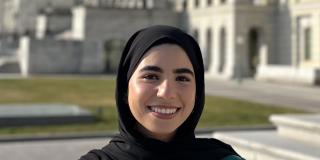
Nonya Khedr is a Master of International Affairs candidate at Columbia University’s School of International and Public Affairs, concentrating in Human Rights and Humanitarian Policy with a regional specialization in the Middle East. She earned her B.A. in International Studies from The City College of New York.
Prior to SIPA, Khedr served as Grassroots Advocacy Coordinator at Amnesty International USA, where she led national organizing efforts and legislative outreach. She also founded SheFFA, a nonprofit focused on eradicating Female Genital Mutilation, and was appointed by the New York City Mayor’s Office to a task force dedicated to ending the practice. She later worked in the U.S. House of Representatives as a Legislative Fellow in the office of Congresswoman Alexandria Ocasio-Cortez, where she focused on foreign policy and conducted diaspora research. As a Charles B. Rangel Fellow, she gained hands-on diplomatic experience while working in the Political Section at the U.S. Embassy in Riyadh.
Khedr is a Colin Powell Fellow, Clinton Global Initiative Fellow, UNA-USA Emerging Leaders Fellow, and NYU Public Service Fellow. In her free time, she loves exploring new places, spending time with loved ones, and meeting new people.
Did you choose to attend SIPA to change careers or to gain experience in a career path you already had experience in?
I always knew I wanted to pursue graduate school, and after taking three years off between undergrad and SIPA, I felt it was the right moment to return to academic learning. My background spans international affairs, public service, and human rights, and I chose the MIA program to build on that foundation, deepen my expertise, and reenter the workforce with stronger credentials. It’s been one of the best decisions I’ve made — I’ve learned so much already, and the degree has opened new doors. While the job market can be challenging, I know that earning a graduate degree from Columbia positions me to be a competitive candidate moving forward.
What most surprised you about SIPA after you arrived?
I was surprised by the diversity of SIPA’s student body, with international students making up over 50% of the class. This global community brings a wealth of perspectives and experiences into every discussion, making learning at SIPA more dynamic.
Can you comment specifically on some exciting things about your concentration?
Since college, I’ve had a deep interest in human rights and have worked in the field for over five years. Coming back to school has been exciting because I can connect my professional experiences with the academic side of human rights. My concentration allows me to explore questions that go beyond theory and into practice — for example, in Rethinking Human Rights and Humanitarian Policy, we examine whether human rights as law, policy, and advocacy are expanding or contracting, and how they remain relevant in different political contexts. In Children’s Rights Advocacy, I’ve been able to develop practical skills through case studies on issues like child labor, migration, and juvenile justice. Courses like International Human Rights Law also challenge us to think about not just what rights exist, but who is responsible for enforcing them and how advocates can use legal and policy tools to make them real. Together, these classes have deepened my understanding of the complexities of human rights while equipping me with tools I can apply directly in future policy and diplomatic work.
What’s your internship experience been like?
This summer I interned in the Political Section of the U.S. Embassy in Riyadh, where I supported U.S. engagement on governance, human rights, and regional diplomacy. My work included attending meetings with Saudi officials and regional organizations, drafting reporting cables and briefing materials, and observing a Specialized Criminal Court hearing for a human rights defender. The experience gave me practical insight into how U.S. diplomacy is conducted on the ground, sharpened my diplomatic writing skills, and strengthened my commitment to pursuing a career as a U.S. Foreign Service Officer.
What kind of work do you hope to do when you graduate?
After graduation, I hope to serve as a U.S. Foreign Service Officer, specifically as a Political Officer focusing on human rights reporting in the Middle East. I want to contribute to strengthening diplomatic ties while ensuring that governance and human rights remain part of the broader policy conversation. This path directly connects to my concentration in Human Rights and Humanitarian Policy at SIPA, where I’ve gained the analytical and practical tools needed to evaluate complex issues, draft policy-relevant reporting, and engage across cultures. My academic training and professional experiences together have prepared me to represent the United States abroad with both rigor and sensitivity.