The Scarves That Traveled
Capstone is perhaps the most exciting course we look forward to in our two years at SIPA. It’s the one project that requires you to step out of the classroom and into the world, to test every idea you have debated, every memo you have written, against the chaos of reality. But when you are choosing a capstone project, it’s not just about the subject or the client. It’s about the kind of journey you want to go on and who you want to take it with.
You are teamed up people you barely know, hoping they will become colleagues. If you are lucky, they become something more. You hope for long nights that end in laughter, for honest conversations over group edits and breakfast wraps, and for fieldwork that stretches you, frustrates you, and makes you feel more alive than any classroom ever could.
The first two months of our capstone were full of anticipation. Spring break became a mental checkpoint, the moment the work finally leaves the pages. We spent hours building interview guides, crafting questions that might land differently once translated across cultures and time zones. We mapped out stakeholders with precision and a little guesswork. And then, when the logistics got overwhelming, we let ourselves imagine the rest: the smell of street food, the hidden museums, the long walks that reminded us why we signed up for this in the first place.
But no one tells you what to do when the very systems and policies you are studying, turn against you.
Our capstone was supposed to take us to Jordan. Tickets booked. Visas stamped. Interviews lined up. And then came the most unexpected news: Pakistan was being considered for a potential travel ban. We watched our trip slip through our fingers. Slowly, then all at once.
The two of us; both Pakistani nationals; found ourselves in a kind of limbo. While emails with travel advisories landed in our inbox, we kept writing to our client, finalizing the itinerary, pretending for a moment that nothing had changed. We were experiencing what we call the first stage of grief; denial. But amidst every update, every Zoom call, was the same unspoken question: do we go anyway? Do we risk it? There was lingering helplessness and desperation.
When we told the rest of the team, we expected frustration. Maybe even resentment. Instead, we got something else; silence at first, followed by sadness. And solidarity. A quiet, collective grief for the trip we had planned together. It was the first time I truly felt what policy means not just in theory, but in its often asymmetrical and unfair impact. The power it holds to include or exclude, to grant access or take it away.
We went from denial to anger and then to the last stage of grief, acceptance. The two of us could not go. That was that. And the six who could, now had to carry the entire trip. The workload doubled overnight, back-to-back interviews, logistical chaos, endless field notes. But no one complained. They just quietly repivoted in support. Because that is what good teammates do.
But what they did next was beyond work. It was what friends do.
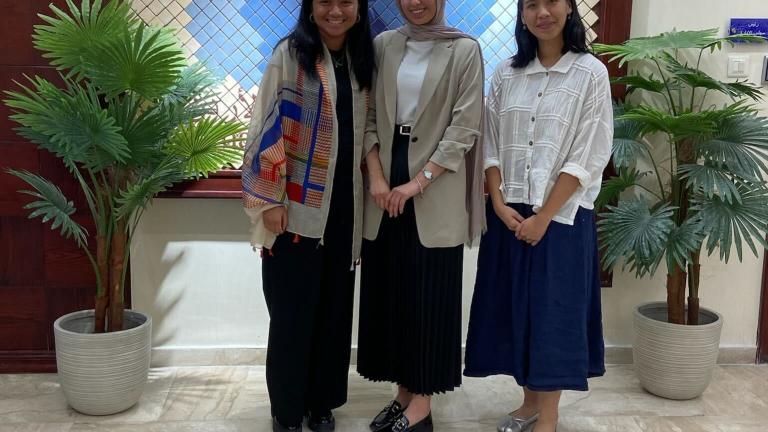
These were people we had not known before December 2024. And now, they were standing in Anum’s apartment with food, small gifts, and a dinner coupon they had pooled together, just to cheer us up. The coupon read, “Dinner is on us, because we can’t change the policies overnight.” They did not have to do this. They could have left with a goodbye on the group chat. But they went the extra mile. They showed up for us.
And then they took us with them. Not literally, but in the most unexpected and moving way. They printed a small poster with our faces on it and carried it across the borders. They brought us into interviews over Zoom, despite spotty Wi-Fi and tight schedules. But what stayed with us the most were the scarves.
They asked us for something personal to carry on our behalf. We gave them two Pakistani scarves, in lieu of the two Pakistani girls who couldn’t travel.
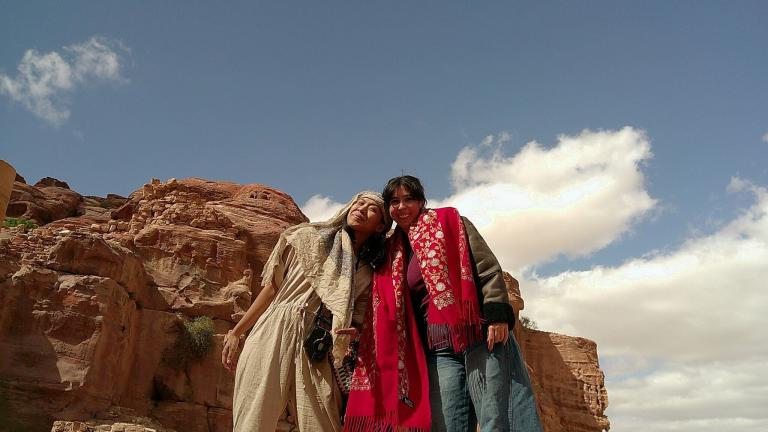
Those scarves went everywhere. They sat in stakeholder meetings and project briefings. They joined our team at dinners and site visits. They made it to the Dead Sea and Petra. They made their way into every photo bright, unmistakable, and full of presence. So, what if we could not go to that factory ourselves? The scarves did. They moved through our capstone experience as our quiet stand ins.
Those scarves told our story. And through them, our team made sure we were never left behind. We never thought we would be part of such a story. But here we are.
This was not the capstone we imagined but in so many ways, it became something deeper. As a policy student, you spend your time learning how to navigate institutions, frameworks, and regulations. But nothing prepares you for when you become a victim of systematic inequalities, when the system tells you that, despite the effort, despite the planning, you don’t get to travel.
What carried us through wasn’t a classroom. It was the people. The teammates who rearranged their lives, carried our stories, and reminded us that empathy isn’t just a nice-to-have it’s a form of leadership. Those scarves, wrapped around their shoulders and tucked into bags, were more than fabric. They were proof that policy doesn’t have to be cold. It can carry warmth. It can carry us.
Our capstone trip was marred by uncertainty, but what emerged was a testament to the resilience and strength of our team as we transformed adversity into triumph. And if these are the people who will go on to shape future policies around the world, then we have hope. The world might just be in good hands.