Ask and You May Be Helped—How I Befriended an Iranian Border Guard at 2 a.m.
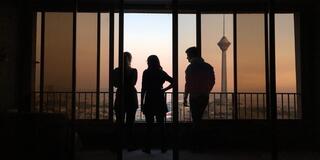
The Raphael Smith Memorial Prize is given in memory of Raphael Smith, a member of the Class of 1994 who died in a motorcycle accident while retracing his stepfather’s adventure of motorcycling from Paris to Tokyo. The prize, established by his family and friends, is awarded annually to two second-year SIPA students for travel articles that exemplify the adventurism and spirit of SIPA.
A tender touch on my shoulder pulled me out of an uncomfortable sleep in an Iranian airport’s plastic chair. Behind me, two Moroccans fought angrily about whose fault it was that their visas weren’t valid, while the young man who had woken me up walked around the table I had rested my head upon. He sat down and looked me in the eyes. His suit was too elegant for this shabby waiting hall and he looked younger than me. Yet, a little needle with the Iranian flag he had pinned to his tie commanded authority.
A sense of subtle compassion appeared on his face as he said in Persian: “My dear, dear friend, we will have to deport you.”
There I sat in Tehran’s Emam Khomeini Airport at 4:30 a.m., afraid of the morning and of this young man. I cursed myself for having brought myself into this situation.
Two months before, I had decided to go to Iran and dive deeper into its culture, its religion, and its history, and study Persian at Tehran’s only language school, the Dehkhoda International Center for Persian Studies. I had studied at the same school two years prior and knew the processes to get an education visa in Iran. I applied. Yet after one and a half months and many frustrating emails, the school kept telling me that my visa was still in some unknown government office.
Alas, not many people travel to Iran these days, and those who do seldom want to study Persian. The language school’s courses thus begin and end in a fixed, six-week rhythm. The trouble was, it was already early April, and I only had time for one specific course that would end in May.
Never mind, I thought. Germans can get a tourist visa on arrival in Iran, so I hoped I’d just get one of those and then charm my way through the spiderweb of Iranian bureaucracy. Two weeks before the beginning of the course, without a visa but with a lot of hubris, I bought myself a plane ticket.
It was 2 a.m. when I arrived in Iran. The late spring night was already warm as I entered the country with a large group of Iranians. We were alone in the vast airport. Just one lonely cleaner in a dark blue uniform mopped the white tiles covering every floor, wall, and ceiling.
I handed my passport to an immigration officer and exchanged the usual bouquet of courtesies with him in the Persian ritual of saying hello. He then guided me to a waiting room which could have been adopted right from a Wes Anderson movie. Everything was orange: the tiles, the chairs, the desks, and the sofas. Dim halogen lamps tried badly to lighten the unicolor setting. I knew that I wouldn’t leave this room without permission.
By now, my thoughts were racing even more quickly than they had been on the plane. Would they let me into the country? Would I be imprisoned?
So early in the morning, the only other person waiting was a Russian language teacher who had come to Iran to visit a friend. Her long blond hair was flowing out from under the mandatory veil.
After half an hour of waiting, the young and well-dressed man entered our orange hall. He welcomed us to Iran and announced that he would first question the Russian teacher, then me.
“Why are you in Iran? Why Iran? But why?”
After 30 minutes of apparently satisfying answers to his repetitive questions, he stood up, calmly walked over, and sat down right in front of me. He was so close he could have touched my knee without extending his arm. “My friend, I am tired. Let’s speak Persian,” he ordered and switched from Oxford English to Tehran Farsi.
I just hoped my charm wouldn’t suffer from having to speak in a language I only knew 500 words of. “There already is an education visa application under your name. Why?” he asked with a wry smile.
I had decided before that I was going to be completely honest and explained to him my situation. I stuttered and took what felt like several lifetimes searching for the right Persian words. Yet, the more I struggled, the friendlier my counterpart became, speaking slowly and clearly, but never switching to English. “I will see what I can do for you, Lukas, my friend.” Then, I laid my head on my arms and fell asleep.
As I woke up and heard the word “deport,” my mind froze and my sleepy eyes grew sharp in an instant. In Persian, English, and German, “deport” is pronounced and written the same way. But in German, it carries with it the sound of screeching train wheels, of shouting German soldiers, and the whispering wind carrying away the ashes of deported and murdered people in our dark and unforgotten past.
The young border guard saw my shocked expression and assured me that I would only be sent back to Germany. It calmed my fears of visiting an Iranian desert prison, but I still felt anxious. I wanted to stay. Why wasn’t that possible? I looked up at him and said: “I am a friend of Iran and am here simply to learn your language. Can you help me?” His eyes pierced me for a mere second, his face expressionless: “I will.”
Sometimes, your future is decided in just one moment. Had I not asked, I would have been sent back to Europe on the next flight. Had I not asked, I would not have seen people’s fear when the American aircraft carrier arrived on its shores, would not have had tea at the British ambassador’s residence, and would not have spent joyful nights driving through Tehran’s packed streets, breathlessly singing along to Guns N’ Roses and Iranian hip-hop with newly found Iranian friends. Had I not asked and had this young man at the airport, whose name I never knew, not helped me.
This story appears in the most recent issue of SIPA Magazine, published in October 2020.