Back to Barbari — and Backgammon
Last week, I got to go back to Iran.
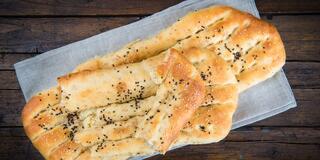
I hastily hopped onto the 1 from West Harlem, rode 17 stops south, and ran up the stairs; my feet barely touched the ground as I ran down 14th Street—just as I’d fly down Khiaban-e Darya-e Noor (literally “Ocean of Light” in Farsi) in Tehran—to the local café where fresh barbari bread, a traditional Iranian bread, awaited me. Th e kind lady behind the counter had stowed away two for me; I think she had sensed the urgency in my voice when I’d called as soon as I’d seen an Iranian woman who bakes the bread locally post about it on her Instagram. I had one hour before my Capstone meeting to make it there and back. But unlike the local nanvaee (bread bakery) in Tehran, there was no wall of impatient Iranians who I would have to elbow to get to the counter. I strode to the counter, my gaze fi xed on the barbari up front. Instead of paying with rials, I tapped my credit card and clutched the two pieces to my chest the entire journey home.
I practiced admirable self-restraint and did not touch the bread until I got home; pre-pandemic, of course, during summers back in Tehran, I was far less patient. I would tear off chunks of fresh, warm barbari right after buying it, almost burning my fingers each time but not caring whatsoever as I gleefully stuffed it into my mouth.
Once back in West Harlem—which my parents had likened to Rasht, Iran, with elderly folks vivaciously gossiping in Spanish on folding lawn chairs in the middle of the sidewalk—I undo the twist tie of one of the pieces of barbari bread. Th e smell of fresh barbari hits me, and my body succumbs to sobs. I brace myself by clutching on to the granite island of my kitchen with both hands; the memories of my grandparents, and mornings in their apartment in Tehran, all felt too real. I miss my bababozorg (grandfather) and sharing simultaneously solemn and spirited breakfasts with him, or hurling Turkish swear words at each other, or coaxing him into a round (five rounds) of backgammon.
“Do o chehar, gol ast o behar. (Two and four, it’s flowers and spring.)”
“Shesh o besh. (Six and five, in Turkish though, not Farsi.)”
So would go the familiar cadence of backgammon with my grandfather; I still whisper the phrases under my breath when I play today, feeling him standing beside me, scrutinizing my every move. I think I’d make him proud.
The game will never lose its wonder for me, and each time I close the board, I look forward to the day I’ll reopen it, along with my memories of Bababozorg and summers in Tehran. My grandpa passed the Friday night after orientation at SIPA; summers in beautiful Tehran passed after the summer of 2015. I have not been able to go back since.
Still, my eyes grow big with wonder and nostalgia every time I spot a backgammon set, though even the flamboyant set a friend purchased from the Museum of Modern Art pales in comparison to the two my grandparents owned in their apartment in Tehran. I’d carefully take out the backgammon set from its handwoven canvas case. It was approximately two feet by one and a half feet, with glossy, checkered caramel and mahogany wood on the outside, peppered with specks of ivory and black on the inside. I loved the feel of the smooth brown and beige wooden circular pieces, with soft velvet underneath, and the smoothest, tiniest ivory set of dice.
Soon, my mother will pass down that set, which is at home in Arizona. I called her to tell her about my barbari find. I meticulously cut off a piece to eat it with labneh—the closest substitute for khameh (cream)—and my mother’s homemade morabay-e albaloo (sour cherry jam), a recipe passed down from my mamanbozorg. I gaze out at West Harlem and New Jersey right beyond the Hudson River, the sun coating the rooftops and river with gold. My mother jocularly reprimands me in Farsi about my audacity to eat barbari without her. She asks me if I’m listening to her; I reassure her. Baleh.
I sit back down at my computer to finish my writing assignment for Farsi class; our class at Columbia comprises mainly native speakers, and we spend the first hour of class in conversation, more often than not debating politics. It feels familiar—like home.
The second hour we focus on Iranian poetry—Rumi, Hafez, Saadi—which is the side of Iran now less often talked about. Visiting the Metropolitan Museum of Art in January 2021, I made a beeline for the Islamic Art collection and sat earnestly down on the wooden bench in front of the Shahnameh manuscripts. For the first time, I can read the lyrical poetry on the beautiful page.
I fight back tears. I sit on the bench, hunched over, until the guard ushers me out of the exhibit.
I pretended, once again, that I am back in Iran. I think Bababozorg would be proud.
About the Raphael Smith Memorial Prize
The Raphael Smith Memorial Prize is given in memory of Raphael Smith, a member of the Class of 1994 who died in a motorcycle accident while retracing his stepfather’s adventure of motorcycling from Paris to Tokyo. The prize, established by his family and friends, is awarded annually to two second-year SIPA students for travel articles that exemplify the adventurism and spirit of SIPA. During this extraordinary year, the scope of the essays was expanded to examine the notion of travel during a global pandemic.
This story appears in the most recent issue of SIPA Magazine, published in October 2021.