CEEP-Fed Conference Tackles Future of Environmental Markets
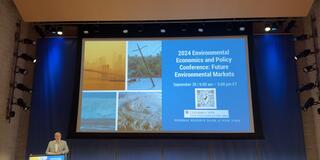
The 2024 Environmental Economics and Policy Conference: Future Environmental Markets on September 20, marked the third time the event, cosponsored with the Federal Reserve Bank of New York and SIPA through its Center for Environmental Economics and Policy (CEEP), was held. The conference brings together leading academics, policymakers, and industry practitioners to discuss critical issues at the intersection of economics, policy, and environmental sustainability.
Douglas Almond, SIPA professor and codirector of CEEP, welcomed guests, while Jeffrey Shaman, interim dean and professor of climate at the Columbia Climate School, kicked off the substantive program by discussing the severe impacts of waste in its various forms on our planet.
"To steward our planet sustainably may require a degree of selflessness and intergenerational thinking and action humans have yet to demonstrate," said Shaman. He challenged the audience to consider how we incentivize long-term, selfless behavior and achieve a near completely circular economy. He emphasized the critical need for cross-sector collaboration, calling for partnerships between academia, business, government, and nonprofits, while stressing that theoretical work must be paired with practical engagement.
The 2024 Environmental Economics and Policy Conference was structured around two main sessions. The first session was on insurance and the second one covered non-financial environmental markets.
Solomon Hsiang PhD ’11 and professor of global environmental policy at Stanford University, delivered a keynote on quantifying climate change loss and damage. He stated that economists and modern analytical tools should be central to efforts to quantify loss and damage, and that economists should engage with this evolving international policy process.
Hsiang highlighted several legally-related questions, including selecting an appropriate discount rate and determining when to start holding emitters accountable and when damages should be “settled up.” He also raised the issue of whether to use consumption or production-based emissions for calculations. In the Q&A moderated by SIPA professor Robert Metcalfe, Hsiang encouraged students to explore legal questions and investigate non-market impacts.
Marguerite Obolensky, a PhD candidate at SIPA, presented research on how migrants seek out familiar climates when relocating. Her coauthored study investigated migrants’ climate preferences in destination selection and the consequences of climate mismatch. She found that migrants tend to settle in areas with climates similar to their home regions, a pattern persisting across different time periods and migration contexts.
The research identified two potential mechanisms driving this behavior: climate-specific human capital and climate affinity. Obolensky also explored the effects of climate mismatch on mortality, finding negative impacts on both older immigrants and infants.