Image
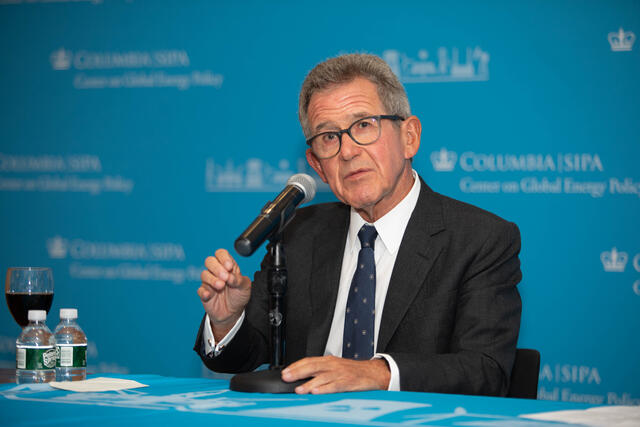
Speaking to a packed house of bankers, engineers, and policy students, Browne looked to the future in discussing the biggest problems we face and how we define ourselves. The September 4 event, organized by SIPA’s Center on Global Energy Policy and moderated by Senior Research Scholar Jonathan Elkind, was convened to discuss Browne’s latest book, Make, Think, Imagine: Engineering the Future of Civilization.
Browne, whose three previous books also explore the intersection of business, technology, and society, contended that engineers are the true drivers of civilization. Society’s essence lies in the interaction between people and products—from the small hand axles that changed the diets of early humans to the Hubble Telescope discovering new parts of the galaxy. These feats are at the core of what society is.
“What really civilization is founded on, in my mind, is engineering,” Browne said. “Because absolutely everything that we do is enabled by something, a product of engineering.”
The philosophical question posed by technological transformation, he said, is not whether a product can be built, but whether it should be built. That moral question of its impact on society is the role of non-engineers. In particular, policymakers charged with crafting guidelines, regulations, and controls.
“When we have a problem, rather than doing less engineering we need more engineering to solve the problem,” Browne said. “Secondly, we need wise and appropriate controls on what we do.”
As a former petroleum executive, Browne said, he is intimately aware of the unintended consequences of man’s success in harnessing energy from fossil fuels.
“This is what the mix of energy is today—eighty-five percent is fossil fuel, he said. “Four percent is renewable energy. The rest is a mix, including nuclear power… the question is how to get from here to somewhere different.”
Fully recognizing our overdependence on fossil fuels, Browne estimates the transition to renewable energy will be both tough and long. Suggesting a two-pronged approach, Browne pointed to controlling the methane emissions to the atmosphere and capturing the carbon dioxide produced.
One byproduct of the technological age is man’s inclination toward false hope and fear. Notably, Browne discussed the pervasive fear of robots eliminating jobs, taking a closer look at the evolution of work over time. More than 120 years ago the average work week was 70 hours. Thanks to the industrial revolution and labor laws it is now 35 hours a week.
“Why do we then define work as a 35-hour week? Why can’t it be 17-and-a-half?” Browne asked. “It’s a fear which we need to realize the solution here is the consequences the results of automation, and engineering but the solution is in public policy.”
That tension between the policymakers and engineers represents the greater struggle between good and evil. Innovations like drones offer societal benefits—delivering medical supplies to victims of natural disasters, for instance—but may may also be used to destructive ends. Dual purpose creations, Browne said, require a hard look at both the product and society as a whole.
In the end, money is what controls both the engineering and the policy solutions. Those in attendance whether municipal bonds banker or the retired engineer, asked how governments will afford transformative engineering projects to combat global challenges like climate change?
The creative solutions, Browne said, must be the shared responsibility of government, industry, and citizens of the world.
“Equity determines that every human has an equal share of the atmosphere,” he said.
— Daniel E. White MPA ’20