Image
Humans grasp the concept of time as the progression of existence, a measure that doesn't discriminate against age, gender, or nationality. But in the Japanese prefecture of Fukushima, the divide between past, present, and future blurred out after 2:46 p.m. on March 11, 2011. A trifecta of disasters—an earthquake, a tsunami, and a nuclear meltdown—scarred Japan, though for those who call Fukushima home, an open wound remains.
I arrived in Okuma, Fukushima, a few days before the 13th anniversary of those disasters. A Japanese friend, who had organized an educational trek for several Columbia students, had arranged for us to enter one exclusion zone—an area where accumulated yearly radiation remains too high for humans to live permanently. Ironically, I was one of the first to express interest in visiting Fukushima, despite being terribly afraid of radiation.
Having grown up in Mexico—a country with ample tectonic activity—I empathized with Japan's complicated relationship with earthquakes, though I couldn't say the same about nuclear-related disasters. I equated radiation with danger. However, in science, it's all about perspective. For radiation to be deadly, one would need to absorb at least four sieverts—units for absorbed doses of radiation. Again, scientific perspective comes in: Our group would've needed to stay two weeks in Fukushima's exclusion zone to absorb one millisievert, which is one-thousandth of a sievert. Simply put, it would take several years of remaining within the exclusion zone for any radiation poisoning symptoms to appear. Despite being aware of these facts, fear nonetheless kept me in a chokehold.
To make matters worse, a conversation with my parents heightened my anxiety. "Are you sure? Won't it be dangerous? Can you back out?" Their valid questions, which came from a place of loving concern, managed to persuade me. Days before the trip, I told my friend that I would not visit the exclusion zone, which was scheduled for our last morning in Fukushima; instead, I and those who had decided not to enter would stay at a nearby location. That day, as we drove toward a meeting point where we would split into groups, my family's questions reverberated in my head, intrusively trying to keep me from changing my mind again.
Yet somehow, in the blink of an eye, I verbalized: "I'm sorry. Can I still join you?"
My friend laughed. "Are you serious?"
"Sumimasen onegaishimasu (Excuse me, please)," I said. I found myself saying sorry and please in Japanese while expecting a flat no for an answer.
I was wrong, though. "Hai, daijoubu (Yes, no worries)," a man, who turned out to be our excursion guide, answered politely in agreement to my request. He introduced himself as Kimura-san.
With permission obtained, my group was given individual radiation dosimeters to track millirems—units of radiation exposure—as well as hazmat suits. While dressing up, my adrenaline spiked as my mind quietly calculated how many millirems our bodies would receive in the next hour. Meanwhile, Kimura-san hadn't put on a suit himself; it turned out that he had been inside the zone so many times without falling ill that he found it pointless to wear protection. His decision left me somewhat relieved.
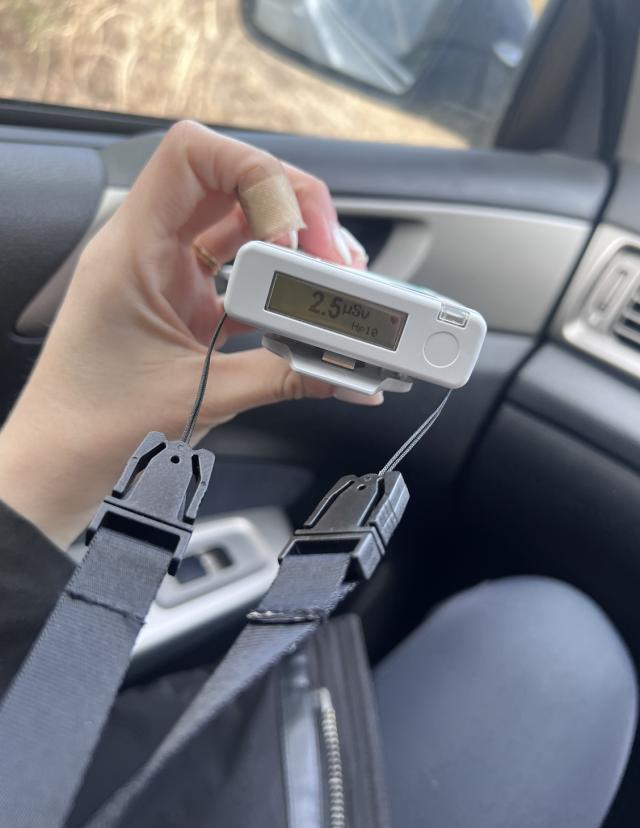
With our individual dosimeters hanging from our necks like necklaces, we ventured into the grounds of an abandoned elementary school. "Mite kudasai (Please look)," Kimura-san signaled and asked us to look at his dosimeter, which he placed near the ground. The screen showed 24 microdose rates per hour. I mentally calculated again: One thousand microsieverts equals one millisievert per hour...
Our attention switched to a nearby classroom, a window separating us from the contents within—wooden school desks with books on top, notebooks scattered across the floor, and a blackboard with the date written in kanji: March 11. This wasn't just any classroom—this was the place where Kimura-san's daughter Yuna had once studied. After the earthquake, Yuna's class evacuated the school grounds to safety. She was later picked up by her grandfather, who was unaware of the incoming tsunami. They both returned to Kimura-san's home by the sea where they lived and were never seen alive again. Yuna's remains were found five years later, thanks to the persistence of Kimura-san, who to this day refuses to sell what's left of his property to the Japanese government as a form of protesting and demanding that Fukushima not be forgotten.
Kimura-san pointed to Yuna's desk, her belongings left untouched since that day. Authorities had prohibited any entrances to the building, leaving Kimura-san to grieve his daughter through her belongings from a painful distance. Standing by the classroom's window, I pictured the glass acting as a time portal, partitioning yet connecting the present and the past. At that moment, all my anxiety toward radiation units felt foolish and selfish. I realized that these doses meant nothing in a place where time was basically frozen. Kimura-san didn't care for hazmat suits or radiation. The only thing he wanted was to feel close to his daughter, even if it meant just looking at what she left behind.
As we left, I noticed the turret clock from the school's main building, its hands displaying the time: 2:46 p.m. I comprehended then that in Fukushima, radiation is not what people like Kimura-san are afraid of. What they fear is the passage of time turning into amnesia—victims left forgotten. Today, 14 years after that fateful earthquake, those who remain in Fukushima continue advocating for the world to see them as a cautionary tale. I no longer associate Fukushima with units of radiation, but with a powerfully resilient community instead, one that strives to be defined, not by tragedy, but by the desire to heal its wounds.
On the train to Tokyo, I texted my mom to share about my change of heart. "I kind of figured you would do it anyway," she confessed with a smile emoji. I was smiling too.
The Raphael Smith Memorial Prize is given in memory of Raphael Smith, a member of the Class of 1994 who died in a motorcycle accident while retracing his stepfather’s adventure of motorcycling from Paris to Tokyo. The prize, established by his family and friends, is awarded annually to two second-year SIPA students for travel articles that exemplify the adventurism and spirit of SIPA. The winners of this year’s contest are Mustapha Dukuly MPA ’25 and Adalí Frias Deniz MIA ’25.