Image
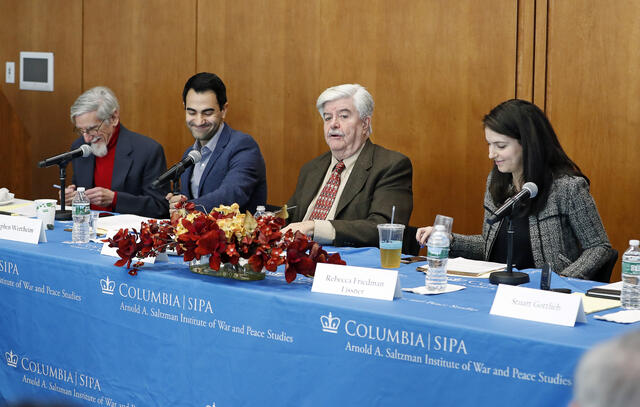
The story of the liberal world order is parallel to the story of Columbia SIPA. The school was founded in 1946, when world leaders were grappling with the daunting challenge of creating a new order of peaceful relations and integration one year after the conclusion of World War II. SIPA pioneered the education of future leaders to uphold and refine the nascent order as its mission. That is why, when a panel at the world’s most global public policy school asks, “Is the Liberal World Order Worth Defending?,” it is not merely an academic exercise, but also a reflection on the school’s raison d’être.
The October 23, 2018 panel was hosted by SIPA’s Arnold A. Saltzman Institute of War and Peace Studies and moderated by Richard Betts, director of the International Security Policy concentration at SIPA. The panelists included Stuart Gottlieb, adjunct professor of international affairs and public policy, Robert Jervis, Adlai E. Stevenson Professor of International Politics, Rebecca Friedman Lissner, assistant professor of security studies at U.S. Naval War College, Jack Snyder, Robert and Renee Belfer Professor of International Relations, and Stephen Wertheim, visiting scholar at the Saltzman Institute. The speakers vigorously discussed three pressing questions: What is liberal world order? What led to its recent demise? And, what should the next world order be like?
“The liberal world order does not exist in form that experts claim,” Wertheim said. The distinction between the post-World War II order, he said, was marked by bipolarity of superpowers. The post-Cold War order is marked by unipolarity of the United States. Critics of President Trump, Wertheim said, mystify rather than clarify the history of the world order, and that the “nostalgia” for the “massive abstraction” made up of incoherent systems and contexts does not offer solution to real challenges.
Lissner defined the tenets of the liberal world order as “open markets, free trades, collective defense, legal constraints on the use of force, democratic community, and positive-sum international cooperation facilitated by multilateral institutions.” She agreed with Wertheim that the history of the order is not monolithic and Trump is not a long-term threat. But she highlighted that, in unrivaled global hegemony after the Cold War, “the U.S. strategy has been more remarkable for its restraint than its unfettered exercise of coercive power, despite a slew of regrettable excesses.” Also, all forms of world orders are “transitory.”
“I want to remind of very important basic facts,” Snyder said. “One is that there has never been a state other than Singapore that has negotiated its way through the middle-income trap to high levels of per capita income, sustained economic growth, and political stability without being a full-fledged democracy with full-fledged rule of law, civil rights, and human rights. The second fact is the democratic peace. No two mature true democracies have ever fought wars against each other. I submit that these are the two most important basic facts we now know about modernity on planet earth.”
He expressed doubts about the rise of China because he sees “the warning signs” that the country is following the steps of other illiberal powers that have “collapsed from inefficiency” or “have flamed out in an orgy of authoritarian nationalism.”
Gottlieb cited two reasons for the current crisis of the liberal world order. The first, the “ideological hubris and policy overdrive” of the United Nations, European Union, North Atlantic Treaty Organization, and World Trade Organization to move too quickly after the end of Cold War to expand their missions as their “own undoings”. Second, in addition to religious totalitarianism and autocratic regimes, “the biggest threat to the order comes from within.” He pointed out that the crisis of the order began inside its two major guardians — the United States and the United Kingdom — and that Trump and Brexit were merely symptoms.
There are inherent contradictory tensions within the liberal world order including liberty versus equality as well as unregulated markets versus democratic participation, Snyder said. The liberal world order has provided buffers to citizens from unexpected changes by developing the Keynesian regulation of the economy, creation of the democratic welfare state systems, and Bretton Woods-types of institutions at the international level. However the solutions have created their own problems. The people who are running the order have become “aloof from the people that the order is meant to serve” and are slow at grasping changes.
Jervis said Trump has done “irreparable damage” to the liberal world order by signalling to allies dependent on the United States for security that democracies are not steady with their commitments. He agreed with others that foreign policy starts at home, and that failures of the West to cope with the winner-take-all economics and massive flow of immigration are the main causes of the crisis. He reiterated that academic elites like himself need to be careful about giving “wholesale endorsements” on sensitive issues. For example, elites often only get to see the benefits of cheap labor and exotic restaurants from immigration without addressing the concerns of others.
Lissner identified three major trends that need to be addressed for the new kind of world order for the 21st century.
“First and most importantly, we have the challenge of China and Russia as revisionist great power competitors,” he said. “As U.S. hegemony erodes, so too will the willingness of our near-peer competitors to tolerate an order wherein the distribution of the benefits do not reflect the distribution of power. The second trend that challenges the liberal international order is technological change…creating under-governed or ungoverned spaces where the boundaries of acceptable state behavior are ill-defined, and the threshold for sovereignty violations are lowered. Third, if governments cannot address the social and political anxieties afflicting the entire West, the liberal component of the order predicated on open societies and markets will collapse. So for those three reasons, defense of the liberal international order is not enough. Instead, it is time for a strategic reckoning.”
Snyder agreed with the need for a revised new order. He cautioned against just copying welfare states, calling for an environment for “well thought out information and discourse,” which is tightening due to the intractable information revolution. For example, he advocated for professional journalists to have more oversight over social-media content in order to preserve the value of free and independent media in liberal democracies.
Jervis agreed with the rest of the panel by saying “we cannot go back to January 2017.” He concluded that the liberal world order “did not create world peace,” but its constraints and rule of law have led to “unprecedented period of peace.” Gottlieb asserted that the liberal world order was worth defending because the failure to do so right after World War I had led to anarchy and World War II. He agreed that the West needed a “reimagination” for this century.
During the question and answer session with the audience, the speakers agreed that global economic integration has been much more successful than the political-military dimension since the end of World War II. The heightened expectations after the collapse of the Soviet Union had led to disastrous attempts at spread of democracy by both the U.S. and international institutions.
The United States will be able to maintain its military and economic primacy as the single most powerful state. China is not growing as fast as it used to, which will make it even more difficult to catch up to the U.S. military capability and Russia is still in decline. Financial institutions around the world seem to agree that that are no alternatives to the U.S. dollar as the global currency anytime soon. However, it is the U.S. domestic politics that could pose a problem with maintaining global leadership, and it is difficult to determine whether global economic integration could continue without American leadership.
All speakers nodded in unison when Wertheim said SIPA wouldn’t have held the panel on this topic just a couple of years ago. The discussion also revealed a simple fact that is often lost in the frenzy of policymaking as well as graduate school life:
“We must accept that the next 70 years of international politics will not resemble the last,” Lissner said.
For the past 70 years, SIPA has cemented its leadership in global public policy education as the liberal world order triumphed in a way few world leaders in 1946 would have imagined. It may be time to once again envisage a new world order by adapting to rapid changes and at the same time, uphold the values of peaceful relations and integration. Just like SIPA had pioneered the mission of preparing leaders for unpredictable challenges 70 years ago, the school must once again gladly take up the tall order of helping shape a new peaceful world order for the next 70 years.
Jeenho Hahm MPA ’19