Norwegian Prime Minister Outlines Energy Transition at World Leaders Forum
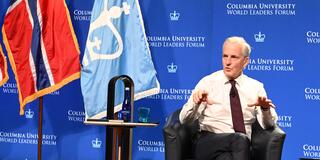
In a dialogue at Columbia University’s World Leaders Forum on September 24, Norwegian Prime Minister Jonas Gahr Støre outlined his nation’s plans to navigate the global energy transition. The conversation, “Norway and The Age of Energy,” with Jason Bordoff, founding director of SIPA’s Center on Global Energy Policy (CGEP), shed light on Norway’s strategy to leverage its energy expertise while addressing climate change and energy security challenges.
Støre emphasized Norway’s unique position as a longstanding energy producer now pivoting towards sustainable solutions. Norway’s extensive coastline, the second longest in the world, is a significant advantage for offshore wind development, he said. Støre also stressed the importance of Norway’s continental shelf, which has been crucial for oil and gas production and now offers potential for renewable energy projects. The country is actively developing offshore wind, hydrogen production, and carbon capture and storage technologies to facilitate its clean energy transition. Støre also highlighted Norway’s $1.6 trillion sovereign wealth fund, now generating more revenue from financial investments than gas.
Bordoff asked about the economic challenges faced by renewable energy projects and the scaling back of some initiatives in Norway. Støre acknowledged the complexities of the transition but remained optimistic about the potential of offshore wind.
Norway plays a dual role as a clean energy leader and a major oil and gas producer, which Støre acknowledged as “the whole world’s paradox.” He emphasized the need for a balanced approach combining supply and demand-side measures and underlined Norway’s push for CO2 tax. Støre said that with proper emissions control, gas could continue playing a role next to renewables.
Støre emphasized the importance of fulfilling Paris Agreement mechanisms to support developing countries in their transition and incentivizing investments from industrial partners and the private sector. “Because my mantra is still: cut emissions, create jobs,” he said. “You can do both and people fear that this is going to take away their jobs, I think we can create another story.”
He pointed out that 700 million people worldwide still lack access to electricity and advocated for global partnerships, mentioning his involvement in “Mission 300,” an initiative aimed at providing electricity to 300 million Africans by 2030. “It is absolutely feasible,” he said.
When asked about the threats to Norway’s energy infrastructure, Støre drew attention to digital vulnerabilities: “Some will say that the biggest threat to energy infrastructure today is digital.” He announced plans to present a national digital strategy, emphasizing the need for equitable distribution of knowledge and skills. “If this is an elite project, you’re not going to benefit and get productivity,” he said.