Image
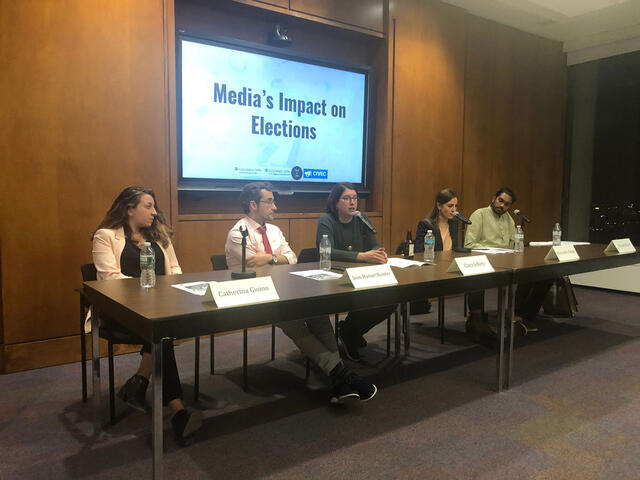
The mainstream media has long kept politicians and public figures in check by reporting on hard-evidenced truth, while politicians have traditionally refrained from expressing blatant falsehoods, in part to avoid criticism in the same media.
Social media may have met the two at an inopportune crossroads.
At a recent event on sought to find an answer on how the two will intersect going forward. Panelists included Risalat Khan, a campaigner for the Avaaz Foundation’s “Correct the Record”; Juan Manuel Benítez MIA ’01, a reporter for NY1; New York state senator Alessandra Biaggi; Mother Jones editor-in-chief Clara Jeffery, and moderator Catherina Gioino MPA ’20, a current student who also reports for the New York Daily News.
Each panelist spoke to their own experiences at the fluid intersection of politics, traditional media, and social media. They agreed it’s a gray area at best.
“We’re fighting against a huge—I don’t want to call it, but—enemy,” said Benítez of social media. “But it has changed. Do people watch TV or videos the same way they used to?”
“I even lost credibility with my mother,” he continued. “She wouldn’t believe what I tell her about a candidate because she saw someone post a video via WhatsApp..... She believes that video, no matter how the video has been doctored or has some sort of a political agenda.”
Panelists said the issue is a growing concern, as media and news sources become all the more manipulated. It also might give credibility to nonmainstream sources that would have gone unheard, which raises a different concern.
“In some ways, it has become more democratized, there are more sources,” said Jeffery. “It’s not old white dudes controlling everything. There’s not just four TV stations and the paper.”
“But that dramatic kind of flattening of media, and, even with journalistic values, there’s a lot of room for intentional or unintentional disinformation. And it’s spread, often intentionally, super quickly,” she said, adding this poses problems for both journalists and their subjects.
“A lot of what journalists are doing now is trying to beat that back, both with our own coverage, but one of the most important things we can do is expose the way disinformation works.”
Biaggi, who is in her first term in office, spoke about how she, as a legislator, interacted with the media. She explained that when she began her campaign for office in 2018, she announced the run not via a conventional press conference but rather through a social-media blast.
“We all, through some agreement in society, accept the sky is blue. We all agree the sky is blue,” she said. “When you take that concept and drill it down into politics, it’s so incredibly complex.”
This is due to a lack of media literacy and a culture of complacency with visuals, Biaggi explained. “We’re not taught to have critical thoughts about what we see. We just take everything as is.”
“But we have to be on high alert when people with authority deliver a message and we’re going to see less and less people thinking critically,” she added. “That to me is the biggest threat we have at the moment.”
Khan spoke about his time working on the Avaaz Foundation’s “Correct the Record” campaign, an effort to poke through social media giants like Facebook, Twitter, Reddit, and others, and how mind-bogglingly easy it is to spread and track the growth of a lie.
“Platforms could be acting on this right now. They could be showing independently verified fact checks, they could show tertiary findings,” said Khan of Facebook’s removal of fake videos.
Gioino said an issue is people in authority choosing to spread falsehoods rather than stop them.
“People conflate the occupation of journalism as inherently belonging to one political party or the other,” she said. “I’m reporting on a non-political story and people shout fake news. Yet me being there to report that story is an opportunity to voice their own version of truth.”
Benítez agreed the distinction between political ideology and publications has grown less defined, but he believes social media has made committing journalism that much easier.
“I went to Puerto Rico to cover protests in 2005, and I went again this summer to cover the governor resigning,” Benítez said. “I used to write my scripts on a notepad and read it to my editor over the phone, who would then type it up. Then I would go to a news station in San Juan and send my video and interviews. I’d have one story for the whole day.”
“This summer, I started recording video with my phone, and I sent it via Twitter and Facebook. And I was reporting with this little machine,” he said. “It’s a complicated thing, but this allows for quick dissemination. Truth is what we do and hope others strive for.”
“It is inherently complicated, but I am eternally optimistic because if anything comes out of this,” Biaggi concluded, “is we have tested the limits of our democracy to the point where we will come back because there are more people on the side of truth than on the side of misinformation.”
— Craig Antonio Hei MPA ’20
Sponsors: Urban and Social Policy concentration; United States regional specialization; Technology, Media and Communications specialization; SIPA Civic and Voter Engagement Coalition (CiVEC).