Image
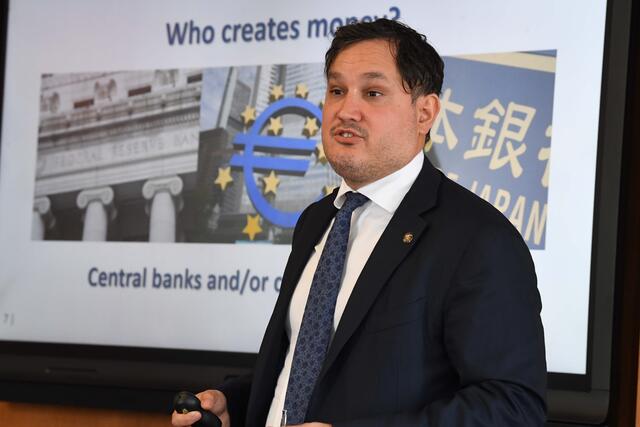
On June 6th, the MPA in Economic Policy Management hosted Márton Nagy, the Deputy Governor of the Central Bank of Hungary. Márton has been the Deputy Governor for the last 4 years, where he has known to be the mastermind behind many of the bank’s unconventional monetary policies and important measures affecting the banking system. Márton had also been the Executive Director of Financial Stability and Lending Incentives of the Magyar Nemzeti Bank (MNB) since March 2013, and now he is the Vice-president. He is a member of the Financial Stability Board and the European Banking Authority. He earned his degree in economics at Corvinus University of Budapest.
The talk at the School of International and Public Affairs, which was moderated by Patricia Mosser, Director of the MPA in Economic Policy Management, focused on the global perspective on how the Central bank’s balance sheet has been changing in the last few years. He also accentuated the future of central banking and how the central bank’s balance sheet could be used for certain purposes, mainly in the creation of money.
Nagy conveyed the underlying reason behind the financial crisis in 2008, being that the financial model solely considered monetary policy without including other key factors such as financial stability and banking sector behavior. This is attributable to the fact that the financial system is not neutral and that it is a vital component of the equilibrium model along with the cause and feedback effect of the real economy.
After the crisis, the focus of central banks in the short term shifted towards increasing lending capability and in the long term towards redesigning the monetary policy framework with the help of unconventional policy tools such as balance sheet policies involving quantitative and qualitative easing and targeted asset purchases and forward guidance to inform longer-term expectations. He further added, “the financial system used to stimulate lending in the US differed from that in Europe such that the US focused on capital market based financing, mainly large scale asset purchase programs in the Mortgage backed securities market and Europe focused on bank loan based financing delivering credit easing measures for the banking sector.”
All things considered, the balance sheets of the central banks have increased after the crisis, accredited to a macro-prudential supervision approach to address financial risks that arise from the gap between monetary policy and conventional central bank policies. According to the Deputy Governor, “the most noteworthy lesson for the central banks was to anchor the unsustainability of its policies ascribed to the dynamic magnitude of the financial sector along with the uncontrolled creation of money by the banking sector that created asset bubbles instead of financing productive investments.”
Nagy ardently expressed the central banking perspective in Hungary, stating that the small open economy in the heart of Europe had a higher average growth than most of its neighbors in Western Europe. The efforts of the MNB were substantiated, firstly, by the economy’s favorable economic developments that were reflected by improving debt ratings that were initially of speculative grade to investment grade. The MNB was also successful in meeting and maintaining the inflation target and significantly decreasing the foreign exchange (FX) ratio of public debt as a result of the self-financing program, in addition to pushing down short-term interest rates.
The way that the MNB achieved these objectives was by employing conventional and unconventional tools at the same time, in a targeted way. The balance sheet policy of Hungary was unique in that it undertook monetary easing with an off-balance sheet strategy which changes the structure of the balance sheet (for example- using Interest Rate and Foreign Exchange Swaps) affecting liquidity without increasing the balance sheet. This policy is in contrast to the on-balance sheet policy of the Fed, the European Central bank and the Bank of Japan which increases the size of the balance sheet (for example – using asset purchases) affecting liquidity by increasing the balance sheet.
The MNB’s targeted programs included the ‘Funding for Growth Scheme’ with a focus on benefitting the Small and Medium Enterprise (SME) sector which creates a mandate for the banking sector to lend only to SMEs and a Mortgage Bond Purchase program which incentivizes banks to provide fixed mortgage loans to the household sector which helps in getting rid of the interest rate risk.
Additionally, the MNB will launch its Bond Funding for Growth Scheme in order to improve the efficiency of the monetary transmission mechanism along with promoting the diversification of financing and strengthening financial stability and increasing the liquidity of the corporate bond market. In the likelihood of a crisis, this enables quick and efficient intervention by the Central Bank.
Nagy predicts that the real interest rates are likely to remain below their historical average in the future. He is also suggestive that structural factors including changing demographics, rising inequalities, globalization, decline in potential growth rates and technological progress play a contributing role in influencing growth, inflation and interest rates.
He points out that advancement in digital technology would help lower costs, increase productivity and competition and in this way, result in lower inflation levels. He weighs in on the potential explanations for the slowdown in economic growth which could arise from medium-term financial factors by the restructuring of balance sheets or from long-term real economic factors by secular stagnation.
The biggest obstacle that faces the central bank is the burden of high debt. If the circumstance demands monetary tightening by the Central Bank, the risks would be excessive. The outcomes of this would lead to unsustainability of public debt, increase in the number of zombie firms and declining consumption and investment due to rising interest expenses.
At present, money creation lies solely within the purview of the central and commercial banks. However, with the onset of digital, global currency in the form of cryptocurrency, this brings in private entities into the money creation arena, which means a myriad of challenges for the central bank in terms of regulation and other implications.
Nagy pointed out two scenarios that could transform the future of money. First, where private entities create and define money, which would mean that the central bank has no control over its creation and that these entities could possibly define inflation. Second, the Central Bank could introduce its own digital currency. This would facilitate the possibility for corporations and individuals to open accounts with the central banks directly which extinguishes the reliance on capital, liquidity rules, regulation and so on. Since all the accounts are held under one roof with the central bank, this would make operations much cheaper and faster. In the event that this scenario is likely to occur, Nagy cautions that it would mean that the Central Bank to first adopt this digital currency would wield insurmountable power and will therefore be unable to remain independent.
When asked about the additional policy options available to Central Banks in view of projected negative real interest rates for the future and the utilization of quantitative easing during the financial crisis, the
Deputy Governor’s response was “given that the Japanese Central Bank has shown the way for additional policy responses in a negative interest rate environment such as reducing rates on the long end of the curve, buying equities (not just bonds) and buying Exchange Traded Funds (ETFS's), this would mean direct interference in other markets which the Central Bank had previously not directly intervened, and thus effectively giving the Central Bank additional powers.”
Between 1998 and 2000, Márton worked as an analyst at the Government Debt Management Agency. In the following two years he was chief economist of ING. He joined the MNB team in 2002. Between 2015 and 2017 he was the head of the board of directors of the Budapest Stock Exchange. He is the author of numerous research materials, analyses and articles, he provides an analysis of the challenges the financial system is to face. In the course of his professional activities he focuses closely on solutions of foreign currency lending to households, and the facilitation of financing small and medium enterprises. The main fields of his research are bank competition and efficiency, pricing of bank products, sustainable lending and the U.S. subprime mortgage crisis.
-Marsha Monteiro (MPA '20)