Image
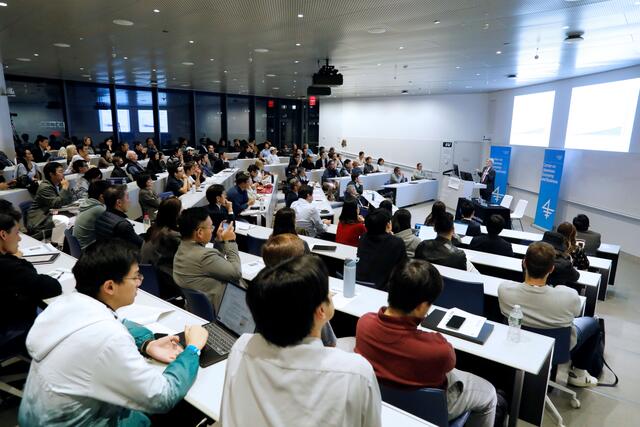
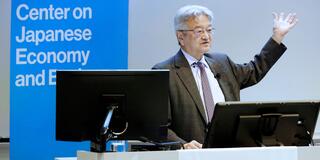
The three significant challenges facing the Japanese economy are: demography, debts, and decarbonization. That is the claim made by Takatoshi Ito, SIPA professor and director of the Program on Public Pension and Sovereign Funds at Columbia Business School's Center on Japanese Economy and Business (CJEB), in an October 9 event. He delivered a lecture hosted by CJEB and moderated by David E. Weinstein, Carl S. Shoup Professor of the Japanese Economy and CJEB’s director.
Japan's aging population presents significant economic threats. The country's low fertility rate and increasing life expectancy have led to a rapidly shrinking workforce supporting a growing elderly population. This demographic shift impacts both supply and demand sides of the economy, resulting in lower GDP growth potential and reduced consumption.
Ito explained the sustainability issue of Japan's pay-as-you-go (PAYGO) social security system, where younger generations support the elderly through their contributions. "As the ratio of the elderly to the working-age population becomes higher,” he said, “the math works out that the younger generation gets worse and worse off." He noted that South Korea and Singapore are experiencing similar challenges, with China expected to face these issues in about 20 years.
Ito discussed the Government Pension Investment Fund (GPIF), the world's largest pension fund with 258 trillion yen in assets, as a potential mitigating factor for Japan's pension challenges. He emphasized that when managed wisely to maximize returns, the GPIF could address Japan’s demographic challenges. Other potential solutions discussed include increasing immigration, upgrading human capital, especially for women and the elderly, and increasing labor mobility through reskilling programs.
Japan's debt-to-GDP ratio has risen to an unprecedented level of about 250 percent, which could potentially lead to a fiscal crisis or hyperinflation. Ito highlighted two main risks: an increased risk of fiscal crisis if the 2 percent inflation target is achieved and interest rates start to rise, and less fiscal space for expenditures other than Japanese Government Bond (JGB) interest payments.
Ito stated that in the event of a crisis, default is not a viable solution, as it would merely shift the problem from the government to domestic financial institutions. As he put it, "You are solving a fiscal crisis by causing a banking crisis."
He recommended several policy measures for regaining fiscal sustainability like reducing expenditures and raising tax revenues, with a focus on VAT taxes. He also suggested asset sales through privatization of public sector banks and infrastructure, and pursuing higher returns from public pension funds to lessen the social security expenditures burden.
Ito stated that these measures are crucial for addressing the unfair burdens being placed on younger generations. As the debt situation worsens, tax increases will likely be placed on younger generations while the elderly pay less in taxes. Ito stressed the importance of fiscal normalization to lower the debt-to-GDP ratio, which is essential for maintaining economic resilience and preparing for future crises or national emergencies.
Ito highlighted that the country's greenhouse gas emissions have not declined as swiftly as in other nations. He pointed out Japan's notably low adoption of electric vehicles, with only a 1 percent market share, and its continued reliance on fossil fuels, particularly coal, which still accounts for about 30 percent of power generation.
Restarting nuclear power plants, Ito added, remains extremely challenging due to public apprehension following the 2011 Fukushima accident. According to him, a carbon tax could potentially reduce greenhouse gas emissions and do so in an efficient and fair way.