Image
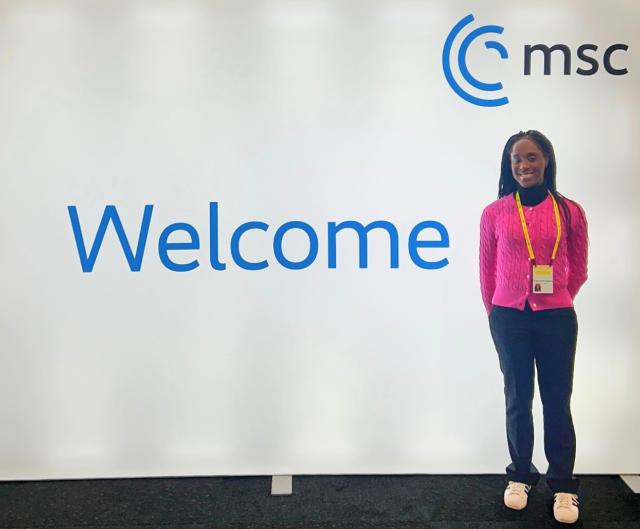
I touched down in Munich running on nothing but adrenaline and airline coffee.
I stood up, stretched my legs, and grabbed my backpack heavy with my school readings, which I had convinced myself I could squeeze in between panels at this year’s Munich Security Conference. I followed the crowd into customs, a reflex I would adopt all weekend long. This was the highest level conference I had ever attended. The rules on the ground, and Germany itself, were completely foreign to me. I was about to learn to navigate them both in real time.
I was struck by how quiet the streets of Munich were. At 8 a.m., I was greeted by nothing but a woman smoking alone outside—a far cry from the ever-bustling streets of New York. I didn’t realize this would be my last taste of silence for the weekend. I was definitely nervous.
As I passed through security, I donned my press badge, and received a copy of this year’s Munich Security Report. Under Destruction, the ominous title read. I shoved it into my backpack and made my way to the press center. The irony of writing about the changing dynamics of global power while sitting in the shadow of Munich’s former royal palaces was hard to miss.
The conference headquarters felt stolid, tightly choreographed, and lacking the energy and urgency I’d anticipated. Police lined every corner. Delegations of military personnel and politicians in suits rushed by journalists. Confused and lost, I attempted to walk past them all without an escort. I didn’t get far. “You can’t turn in there. Go around.” The officer pointed, and I obliged. I was late. I quickly learned to leave early for everything, building in time to navigate the circuitous nature of an environment this securitized.
Over sips of coffee with a journalist from Norway, I told her about a press briefing I hoped to attend later in the day with Reza Pahlavi, an exiled Iranian political dissident and son of Mohammad Reza Pahlavi, the last Shah of Iran.“Oh, yeah, they won’t let you in there. I’ve been getting rejected all day,” she said. We all had. Nearly all of the most high-profile programming took place at Hotel Bayerischer Hof, a muted, austere building long associated with celebrities and royalty alike. Owned by the same family for five generations, discretion is its real crown jewel. At nearly every hour of the day, you could find a throng of journalists nervously pacing outside as they lobbied to be let into an already-full press conference or waited behind a bulwark of police for Ukrainian President Volodymyr Zelenskyy to arrive. Our badges displayed only our last names and a small photo: no first name, no outlet. I thought at first that mine had been misprinted—it hadn’t. In this, we were all granted the same partial anonymity.
Before my arrival, I had heard the Munich Security Conference described as a marketplace of ideas, but in a lot of ways, it felt like the opposite. Rooms were largely full of technocratic European men in suits offering clinical diagnoses of a world in crisis and often circling the same question: What happens in the face of the fraying postwar rules-based order and norms? In one session I attended, a European leader spoke of a crumbling international order that required Europe “becoming more independent.” I thought of Princeton Professor John Ikenberry’s assertions that global cooperation still matters—an idea we grapple with consistently at SIPA. In another session on the politics of water shortages, a leader invoked the global commons: that resources like water belong to everyone.
The core ideological debate focused on which competing visions for the distribution of global power would win out as America cedes the reins of agenda-setting. In the face of collapsing rules and norms, many heralded the possibility of a European-led rules-based world order. Others decried the lack of Global South countries in these rooms—and the clear political vacuum that left. On issues like water security and climate change, countries in the Global South bear disproportionate costs despite often being the least represented in these forums.
As I maneuvered through the conference, I kept thinking this must be both the safest place in the world—and also possibly the least—given how easy it could be to misstep. In each room, the tension was thick as leaders from Ukraine and Sudan implored us all to not forget them. We would all nod, scribbling takeaways into our notebooks. Then we would head to lunch. I found so many of the panels lacked conversations about human impact: discussions centered on the safeguarding of resources but not really on what happens when ordinary people lack them. It felt as though the men in suits on stage were reciting the same technocratic frameworks as life outside the Hotel Bayerischer Hof’s walls was collapsing before our eyes.
Outside the conference, I encountered one of the many protests unfolding that day. In tandem, an intergenerational crowd of thousands was marching past, holding “Anti-SiKo” signs—activist shorthand for the Munich Security Conference, or Sicherheitskonferenz, in German. It was hard to ignore that while journalists sat in cramped rooms listening to world leaders, thousands rallied outside, pushing for more representation. I met high schoolers protesting the German government’s efforts to usher in voluntary military service. I spoke with two longtime activists who told me this was their sixth year in a row demonstrating against an international system they saw as prioritizing conflict over climate change and poverty alleviation. Nearby, a group passed out pamphlets opposing the military-industrial complex. I recognized journalists I had met earlier that morning, their yellow badges winking through their coats as they invited protesters to describe their visions of something different. It occurred to me that these two worlds might begin to splinter and converge sooner than I expected.
Though this year’s official conference theme was “Under Destruction,” on the ground I saw mounting pressure to contest—and to build—what comes next. These are questions I will carry into my SIPA coursework.