Hate Speech and Political Violence: A Q&A with Professor Robert Shapiro on Extremist Rhetoric in Electoral Politics
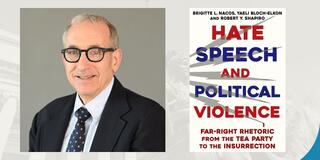
Robert Y. Shapiro is the Wallace S. Sayre Professor of Government in Columbia’s Department of Political Science and a Professor of International and Public Affairs at SIPA. Shapiro specializes in American politics with a focus on public opinion, policymaking, political leadership, the mass media, and applications of statistical methods. He has taught at Columbia since 1982, and received the 2022 Award for Exceptionally Distinguished Achievement from the American Association for Public Opinion Research.
His latest book, Hate Speech and Political Violence: Far-Right Rhetoric from the Tea Party to the Insurrection (Columbia University Press), coauthored with Brigitte L. Nacos and Yaeli Bloch-Elkon, both research scholars at the Institute for Social and Economic Research Policy, traces the evolution of extremist rhetoric in right-wing political discourse from the Tea Party to the Trump era, offering crucial insights into contemporary threats to American democracy..
In this SIPA News Q&A, Shapiro discusses his new book, the role of social media in spreading mis- and disinformation, and what to expect in the upcoming US presidential elections. This interview, conducted by Giulia Campos MIA ’24, has been condensed and edited for clarity.
What key finding do you want readers to take away from your book?
The political environment in the United States has slowly become more conflictual and emotional, and also more dangerous. The big question that no one has an answer to is what can be done to lessen the level of partisan conflict, which has escalated so it feels like being on steroids at an emotional level.
This all comes on the precipice of an election: If Donald Trump loses, we may see a replay of what happened after 2020. Another question is whether we have learned anything from the 2020 election — or have Donald Trump and his supporters learned things that might enable them to accomplish in 2020 what they weren't able to accomplish in 2020?
The big question that no one has an answer to is what can be done to lessen the level of partisan conflict, which has escalated so it feels like being on steroids at an emotional level.
— Robert Shapiro
Misinformation and conspiracy theories have become pervasive in political discourse. How has this impacted democratic governance?
The birther conspiracy theory [that President Obama was not born in the United States] was nonfactual and false, but it represented a type of political content that had helped media outlets like Fox News attract niche audiences and become economically viable. What came later, along with the rise and then election of Donald Trump, were further changes in politics — including newer media outlets that are ever ready to amplify conflict to an extraordinary extent.
Your book examines the interconnectivity of new media and its impact on political messaging. How has this dynamic evolved over time?
The use of social media has helped inflame politics to a significant degree in the United States, but also in other parts of the world. The way misinformation is spread through social media [such as in the Global South] is really quite extraordinary as well. It has generated violence in a way that would be unheard of in the United States — although we’ve begun to see some of that emerge here.
The rhetoric of the Tea Party played a significant role in shaping political discourse. How did this pave the way for the emergence of figures like Donald Trump?
The Tea Party was a movement largely within the Republican Party that opposed Democratic Party politics in a more inflammatory way than before. After Mitt Romney lost the 2012 election, there was growing dissatisfaction with mainstream Republican politics as well. Trump saw an opportunity there and came to epitomize the rejection of mainstream politics in general — which resonated not only with a lot of the existing Republican base but also with the emerging Republican base referred to as the white working class.
SIPA students should pay attention to the interconnectivity of the media and to what extent misinformation and disinformation have been communicated in a much more effective way and on a larger scale compared to truthful, factual information in politics.
— Robert Shapiro
Are there policy reforms that can help address the role of extremist rhetoric, especially on social media?
What SIPA has put high on its current agenda is policy around communication, social media, and the internet, and what needs to be done — perhaps by way of government regulation. SIPA students should pay attention to the interconnectivity of the media and to what extent misinformation and disinformation have been communicated in a much more effective way and on a larger scale compared to truthful, factual information in politics.
How would you characterize the current political dynamic leading into the November elections?
The parties differ on a wide array of issues and they’re very closely matched, with each enjoying its own base of support. Politics overall has become more heated and highly emotional in a way that leads to a certain kind of irrationality: The parties oppose each other so vehemently that it has a distorting effect on perceptions of reality.
The stakes are high: Notably, each party has the chance to achieve unified control of the presidency, the House, and the Senate — a trifecta that also means control of judicial nominations, which can potentially change the direction of government policies in striking ways, as we have seen in the last two decades. But also, we saw Trump raise the threat to American democracy when he challenged election results in a way that led to political violence in January 2021.
How do you see the presidential election playing out in November?
It’s going to be very close. We talk about voters nationwide, but what's really going to matter — because of the electoral college in the United States — is what happens in seven or eight states. We’ve seen recent elections decided by no more than around 70,000 votes in three states.