SIPA Summer Reads 2025
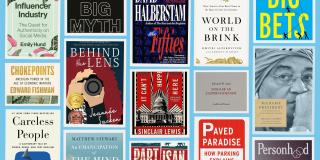
Summer is soon upon us, and whether you need a good vacation read or just something breezy to pass the time, SIPA faculty have you covered. From primers on global affairs to deeper academic dives on big policy ideas, their top picks are sure to capture your minds, on the page and beyond it. Whether you’re poolside or at an airport, these books just might change how you see the world – no homework assignments required, just inspiration.
Dig in and happy reading!
Songs of an Eastern Humanist: Collected Poems, by Edward Said, edited by Timothy Brennan (Columbia, 2024)
Here is a collection of poems that give voice and agency to marginalized communities. As a humanist, Edward Said saw writing communities as essential for the transmission of knowledge, ideas, and values across generations. We all come from diverse backgrounds and bring lived experiences to our University. Our shared traditions and writing communities shape our political identities and foster our growth as thinkers. I hope here at SIPA you build your own community of humanists to help you develop your artistic and intellectual expressions.
— Gizem Acikgoz, Adjunct Assistant Professor of International and Public Affairs
An Emancipation of the Mind: Radical Philosophy, the War Over Slavery, and the Refounding of America, by Matthew Stewart (W. W. Norton & Company, 2024)
Did you know that Abraham Lincoln read both Ludwig Feuerbach and Karl Marx? An Emancipation of the Mind is a fascinating retelling of the background to the American Civil War as a contest between European-inspired philosophical radicals and the conservative slaveholding oligarchy who battled for the American republic in its early decades. Stewart’s book offers a good introduction to this period of American history for those who don't know it – and it’s a great treatment of the importance of principles in politics for everyone.
— Lisa Anderson, SIPA Dean Emerita
The Fifties, by David Halberstam (Villard, 1993; Ballantine, 1994)
The Fifties demonstrates that the turbulent 1960s were clearly foreshadowed by developments of the so-called placid Eisenhower years of the 1950s. The book includes portraits from that decade – of Presidents Eisenhower and Truman, J. Robert Oppenheimer, Douglas MacArthur, Joseph McCarthy, and Richard Nixon. Halberstam also covers the Korean War, the Cold War, civil rights activism, sports and pop culture.
— Peter A. Clement, Adjunct Senior Research Scholar in the Arnold A. Saltzman Institute of War and Peace Studies; Adjunct Professor of International and Public Affairs
Paved Paradise: How Parking Explains the World, by Henry Grabar (Penguin, 2024)
This book explains how widely the storage of cars has shaped the design of human infrastructure, throughout history and in the present day. It's a surprisingly entertaining read, explaining how parking garages became such popular businesses for organized crime, and how Chicago became hostage to venture capital through parking meters. If you want to better understand why the world (particularly the US) is the way it is (at least in terms of transportation and housing), and yell at your book while you do so, give Paved Paradise a read!
— Aidan Feldman, Lecturer of International and Public Affairs
Behind the Lens, Double Exposure, and The Rule of Thirds (The Annie Hawkins Series), by Jeannée Sacken (Ten 16 Press, 2021, 2022, 2023)
In this powerful, heartbreaking trilogy, Jeannée Sacken’s artistic gaze is unflinching as she tells the story of American photojournalist Annie Hawkins. Embedded with coalition forces in Afghanistan, Annie seeks redemption after exploiting a photographic moment in a poor village. On her subsequent return to Afghanistan to help build a high school for girls, she endures being kidnapped by the Taliban. Hampered by PTSD, she covers the Taliban’s return to power. While these are novels, they also convey gripping real-life stories of the struggles women face professionally from patriarchal systems.
— Jeanne Fox, Adjunct Professor of International and Public Affairs
World on the Brink: How America Can Beat China in the Race for the Twenty-First Century, by Dmitri Alperovitch, with Garrett Graff (PublicAffairs, 2024)
Though he started as a hard-core cybersecurity technologist – tracking the cyber intrusions of Chinese and Russian intelligence teams online – Dmitri Alperovitch has since expanded his horizons to the larger competition between Washington and Beijing, from critical minerals to trade, Taiwan, and cyberspace. Teaming with veteran journalist and author Garrett Graff, Alperovitch produces a deeply researched and thoughtful book, calling for US leadership to more actively counter China (and Russia) to ensure a more free and equitable world.
— Jason Healey, Senior Research Scholar in the Faculty of International and Public Affairs; Adjunct Professor of International and Public Affairs
Partisan Nation: The Dangerous New Logic of American Politics in a Nationalized Era, by Paul Pierson and Eric Schickler (University of Chicago, 2024)
We hear a lot about partisan polarization in American politics and the dangers it poses to a healthy democracy. But one important piece missing from these discussions is tracking how our institutions, including our legislatures, states and localities, interest groups, and political parties, interact with and reinforce polarization. Accessible and illuminating, this book offers a new perspective on polarization and how it laid the foundation for a growing authoritarian threat within the Republican Party.
— Alexander W. Hertel-Fernandez, Associate Professor of International and Public Affairs; Vice Dean for Curriculum and Instruction
The Big Myth: How American Business Taught Us to Loathe Government and Love the Free Market, By Erik Conway and Naomi Oreskes (Bloomsbury, 2023)
Conway and Oreskes – authors of a prior classic, Merchants of Doubt (2010), about the origins of climate change denial – have deepened their takedown of corporate interests that drive American politics and policies, taking readers on a historic journey that explains the launch and evolution of the free market mythology that fetishizes the supremacy of business over government in solving both business and social problems. Readers will gain a better understanding of how well-funded, highly effective narratives mislead society and drive adoption of policies that are against the public interest.
— Tanya Khotin, SIPA Adjunct Professor and Brandmeyer Fellow for Impact and Sustainable Investing
Personhood: The New Civil War Over Reproduction, by Mary Ziegler (Yale, 2025)
In the three years since Roe v. Wade was overturned, new fronts have emerged in the battle over reproductive rights – including over abortion medication, IVF, and the legality of traveling out of state to obtain an abortion. This evolution makes clear that overturning Roe was never the anti-abortion movement’s end goal. As Mary Ziegler – a leading historian of reproductive rights in the US – argues in her new book, the movement has always been anchored in the concept of fetal personhood: the belief that a fetus is a distinct human being from fertilization and should be granted constitutional rights. Personhood is a comprehensive historical analysis of a movement shaping American politic
— Jennifer Klein, Professor of Professional Practice, Director of IGP Women’s Initiative
Chokepoints: American Power in the Age of Economic Warfare by Edward Fishman (Portfolio/Penguin, 2025)
Fishman narrates the history of the evolution of US tools of economic warfare. He chronicles not only major strategic decisions by leaders, but also the technical work and determination of dedicated public officials. He roots the story in the unique role of the US dollar as the world's reserve currency, making the book particularly timely at this moment. He imparts crucial details about the role of economic sanctions in giving policymakers an alternative to military force to resolve global challenges.
— Jack Lew, Professor of International and Public Affairs
Safe Havens for Hate: The Challenge of Moderating Online Extremism, by Tamar Mitts (Princeton, 2025)
Tamar Mitts’ exciting book explores online extremism, tackling the puzzle of why – despite social media platforms’ content-moderation policies – we still see online hate groups thriving. She argues that we often treat extremism as a platform-specific problem (i.e., Meta, Telegram, X, etc.), when it is actually an ecosystem-level issue. A perfect read for students interested in emerging technologies, mis- and dis-information, non-state actors, and extremist organizations.
— Erica Dreyfus Lonergan, Assistant Professor of International and Public Affairs
The Influencer Industry: The Quest for Authenticity on Social Media, by Emily Hund (Princeton, 2023)
This book shows that today's "influencer” industry is a full‑scale business that turns personal authenticity into a measurable, tradable commodity that shapes what we buy, how we work, and even how political messages spread. Hund argues that influencers are not a passing fad, but signal a structural shift in the way power, culture, and information operate online. She traces this evolution and surfaces the key policy challenges it creates – from tech regulation and consumer protection to the growing instability of digital work and mounting threats to information integrity.
— Tamar Mitts, Assistant Professor of International and Public Affairs
Careless People: A Cautionary Tale of Power, Greed, and Lost Idealism, by Sarah Wynn-Williams (Flatiron Books, 2025)
This riveting whistleblower account of misdeeds at Facebook covers years of corporate bad behavior as the social media platform threw around its political power and economic might in order to expand operations around the world. Some highlights: descriptions of Facebook acting illegally and stealthily in China and leaning on governments to allow its services in India. This book offers important insights into the tactics and mindset of one of the most influential companies of our time.
— Anya Schiffrin, director of the Technology, Media, and Communications specialization
It Can’t Happen Here, by Sinclair Lewis (Doubleday, Doran and Company, 1935; reprinted by Signet Classics, 2014)
This book was, stunningly, written in 1935 as Hitler’s Nazi party took power in Germany – and described a populist authoritarian leader who was able win the presidency and establish a right-wing extremist dictatorship in the United States. The book’s title captures its main thesis and argument, and its story puts our present in further historical perspective. The elements of this fictional fascist government and people’s responses to it resonate with current politics in the US and elsewhere.
— Robert Shapiro, Wallace S. Sayre Professor of Government and Professor of International and Public Affairs
On the Clock: What Low-Wage Work Did To Me and How It Drives America Insane, by Emily Guendelsberger (Little, Brown and Company, 2019)
A journalist goes undercover to work at an Amazon fulfillment warehouse, a call center, and a McDonald’s. It’s not pretty. Guendelsberger’s reporting brings home how exhausting, stressful, and ultimately dehumanizing so many low-wage jobs are in the US. Her book vividly depicts working-class life in this country, in ways that make a compelling argument for a more humane workplace and may well shed light on the roots of recent political upheaval.
— Eric Verhoogen, Professor of International and Public Affairs and of Economics; Co-Director, Center for Development Economics and Policy
Madame President: The Extraordinary Journey of Ellen Johnson Sirleaf by Helene Cooper (Simon & Schuster, 2017)
Journalist Helene Cooper chronicles the life and career of Africa's first woman head of state, Ellen Johnson Sirleaf. Madame President is an inspiring story of resilience and determination, detailing how Liberian women brought peace to a war-torn nation and providing a masterful lesson in post-conflict governance and development economics. At a time when the Women, Peace, and Security agenda is under attack, this book demonstrates the importance of women’s leadership in resolving conflict and preserving peace.
— Rachel Vogelstein, Associate Professor of Professional Practice, Director of IGP Women’s Initiative
Big Bets: How Large-Scale Change Really Happens, by Rajiv Shah (Simon & Schuster, 2023)
Raj Shah draws on his long career working on the front lines of development to address some of the world’s most serious crises, from Ebola to Covid. Shah’s book encourages us to think big, offering a compelling roadmap for ambitious, outcomes-driven change. With clarity and optimism, he shows how bold leadership and a relentless focus on achievable results can defy inertia and deliver real progress – even in the face of entrenched bureaucracy or political gridlock.
— Keren Yarhi-Milo, Dean and Adlai E. Stevenson Professor of International Relations